

Overview
A B2B SaaS platform that helps businesses run personalised loyalty programmes wanted enterprise demo requests, first in the United States and then in the Gulf. Over twenty months the work spread across three markets and two channels: Google Search in the US and the UAE, and LinkedIn Sponsored InMail across MENA. Together they produced 232 leads and 100 inbound phone calls.
The Pain Point
Enterprise loyalty software is not bought on impulse. The buyer is a committee, the contract runs for years, and the number of companies in any one market that are actively shopping is small. That shapes everything:
- Low volume, high value. A handful of qualified enterprise conversations is worth more than hundreds of small-business sign-ups, so volume targets would have pointed the account in the wrong direction.
- Two very different markets. US and UAE demand, competition and click prices have little in common. Run from one budget, the cheaper market quietly eats the other’s spend.
- Some buyers never search. A decision-maker who is not actively looking cannot be reached through search at all.
The Solution
Each market got its own campaign and its own budget, so neither could borrow from the other and each market’s true cost per lead stayed visible. Bidding moved to Maximize Conversions once there was enough conversion data for it to work with, and call assets were added so a buyer who wanted to talk could do it in one tap.
Search alone was never going to be enough, so LinkedIn ran alongside it. Paid search captures the demand that already exists; Sponsored InMail creates demand among people who were not searching yet. The two were measured separately and judged on lead quality, not lead count.
What We Did
1. Separated the US and UAE accounts
Budget and bids were managed apart so each market’s cost per lead stayed visible and neither market subsidised the other.
2. Targeted the vocabulary enterprise buyers actually use
Industry-specific, high-intent terms rather than broad loyalty-software keywords, which kept small-business and consumer traffic out.
3. Added call assets and CTA-led copy
100 phone calls came through the US campaign alongside the form fills — conversations that a form-only setup would have lost.
4. Went direct on LinkedIn where search could not reach
Sponsored InMail to named decision-makers in the UAE, personalised to lift open rates, with lead forms tuned for completion. The open rate reached 62.81% and form completion 18.3%.
Why the Cost per Lead Looks High
Cost per lead ran from $181 in the US to $317 in the UAE, well above what a high-volume lead generation campaign would accept. That is the market, not the account. Enterprise loyalty software in the Gulf is high-value and low-volume: each of those 48 UAE leads is a potential multi-year contract, and the cost of winning one has to be read against that, not against a benchmark built from small-ticket lead generation. We set cost-per-lead targets per market and per deal value, never one number for everyone.
Results
Across all three markets: $41,126 and ₹90,734 in spend, 232 leads and 100 inbound phone calls.
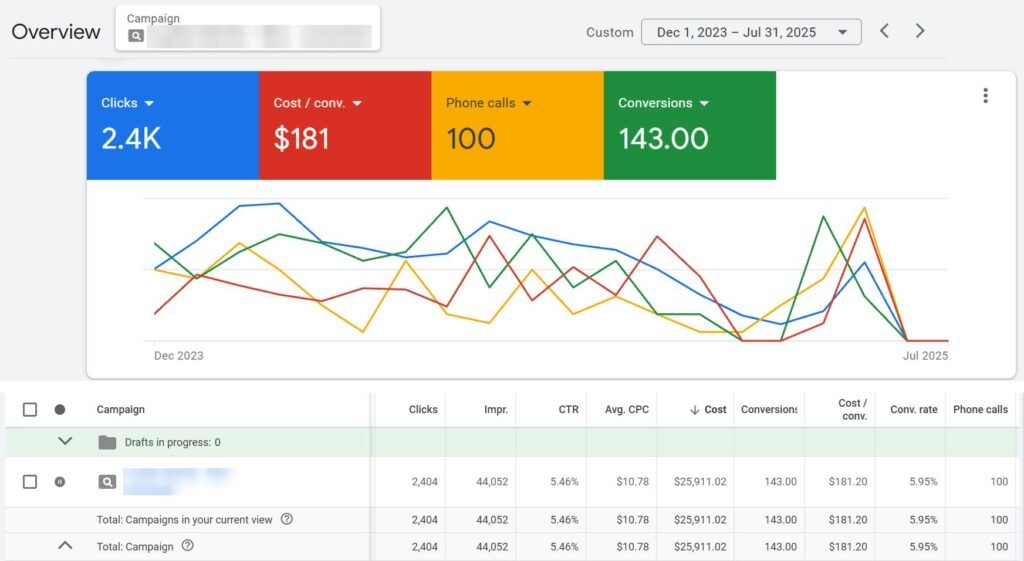
US Google Ads account.
232 B2B leads across three markets. Paid search captures demand, paid social creates it — run together they cover ground neither reaches alone.