

SEO vs GEO in 2026: What Changes and What to Do First
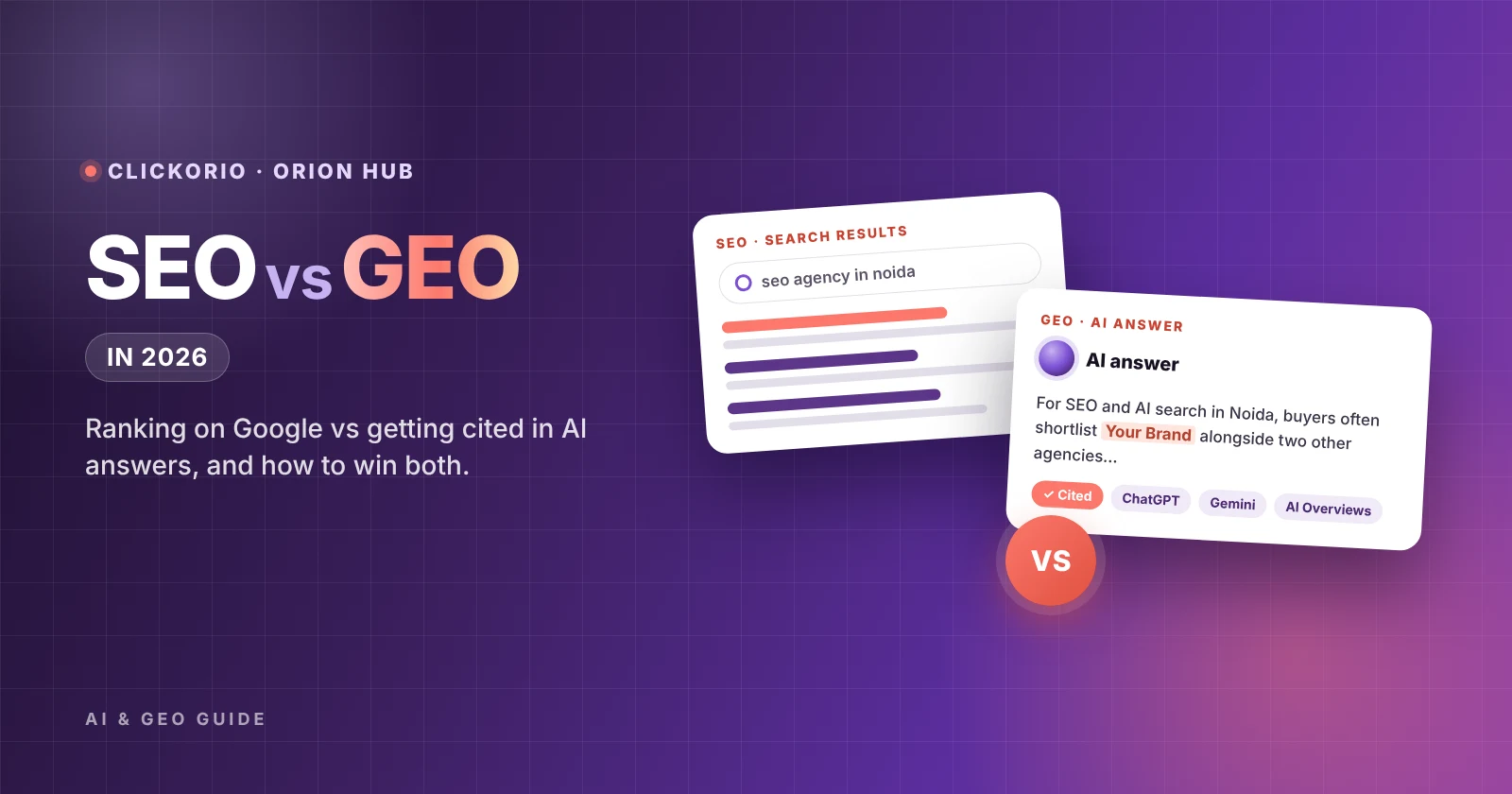
- Buyers now ask AI assistants before they search, and shortlist the brands the answer names.
- SEO wins a place on the results page; GEO wins a mention inside the AI answer.
- AI answers favour pages that are easy to crawl, answer the question first and are backed by trusted mentions.
- Win both with four steps: fix the basics, write answer-first content, earn mentions and track AI answers monthly.
Key takeaway: You do not have to choose between SEO and GEO. SEO gets your pages found; GEO makes them the answer.
Table of contents
Search did not disappear in 2026. It split in two. Buyers still type questions into Google, but many now ask ChatGPT, Gemini, Perplexity or Google’s AI Mode first, read one answer, and shortlist the brands it names. If your brand is not in that answer, you may never get the click.
That is why marketing teams keep asking the same question: should we invest in SEO or GEO? This guide explains what each one means, how they differ, and what to do first so your brand shows up in both places.
What is SEO in 2026?
SEO (search engine optimisation) is the work of earning a place on the search results page. In 2026 it still rests on the same foundations: pages that search engines can crawl and index, content that matches what people search for, a fast site on mobile, and links and mentions that build trust.
What has changed is the reward. A top ranking now sits under AI Overviews and other answer features, so SEO is measured more by leads and revenue than by clicks alone.
What is GEO?
GEO (generative engine optimisation) is the work of getting your brand named, quoted or cited inside AI answers. Instead of ten blue links, the buyer sees one written answer, often with a few sources underneath. GEO decides whether your brand is one of them.
GEO is not a separate channel with its own tricks. It builds on SEO and adds clear facts about your business, passages an AI can quote, and mentions on the sites AI tools already trust.
SEO vs GEO: the key differences
| SEO | GEO | |
|---|---|---|
| Goal | Rank on the results page | Be named or cited in the AI answer |
| Where it shows | Google and Bing results, Maps | ChatGPT, Gemini, Perplexity, AI Overviews, AI Mode |
| Main signals | Relevance, links, page experience | Clear entities, quotable passages, trusted mentions |
| How you measure it | Rankings, clicks, leads | Mentions, citations, how your brand is described |
| Typical work | Technical fixes, content, link building | Answer-ready content, schema, digital PR |
How AI answers choose which brands to mention
When someone asks an AI assistant a buying question, the model looks for pages it can find and trust, then pulls the passages that answer the question most directly. Pages that rank well are easier to find. Pages that answer clearly are easier to quote. Brands that are mentioned across many trusted sites are easier to recommend.
Ranking gets your page into the room. A clear, quotable answer is what gets your brand named.
In practice, this means the same page has to do two jobs: rank for the search, and give the AI a clean answer it can lift without guessing.
How to win both SEO and GEO in 2026
You do not need two teams or two budgets. Start with these four steps, in this order.
1. Fix the technical basics
Make sure every important page can be crawled and indexed, loads quickly on a phone and covers one clear topic. AI tools find pages through the same indexes as search engines, so a page that is hard to crawl is also hard to cite.
2. Write answer-first content
Open each section with a two or three sentence answer to the question in its heading, then add the detail. Use plain names for your services, locations and prices. Add Organization, Service and FAQ schema so your key facts are stated the same way everywhere.
3. Earn mentions on trusted sites
Industry directories, local news, partner pages, review sites and community discussions all help. A brand that is described the same way across many trusted sources is easier for an AI answer to recommend.
4. Track AI answers every month
Pick ten to twenty real questions your buyers ask and check them on each AI platform every month. Note whether your brand appears, which page is cited and how you are described, then fix what is missing.
Common mistakes to avoid
- Treating GEO as a replacement for SEO instead of a layer on top of it.
- Long introductions that hide the actual answer.
- Different business details on your website, Google Business Profile and directories.
- Measuring only clicks and missing brand mentions that never send a visit.
- Publishing thin AI-written pages that say nothing new.
Where to start
SEO and GEO are not rivals in 2026. SEO gets your pages found; GEO makes them the answer. Start with a clean site, clear writing and a brand other sites talk about, then measure both rankings and AI mentions every month.
Want to know how AI assistants describe your brand today? Get a free SEO + AI visibility audit from Clickorio and see the first three fixes we would make.
Frequently asked questions
Is GEO replacing SEO in 2026?
Can a small business do GEO?
Which AI platforms should I track for GEO?
How do I know if GEO is working?

Atik Sid
Atik leads business development at Clickorio, working with brands to plan growth across SEO, GEO and AI search. He connects strategy with sales, so every campaign is built around the questions real buyers ask and the leads that follow. He writes about how search is changing and what businesses should do about it.